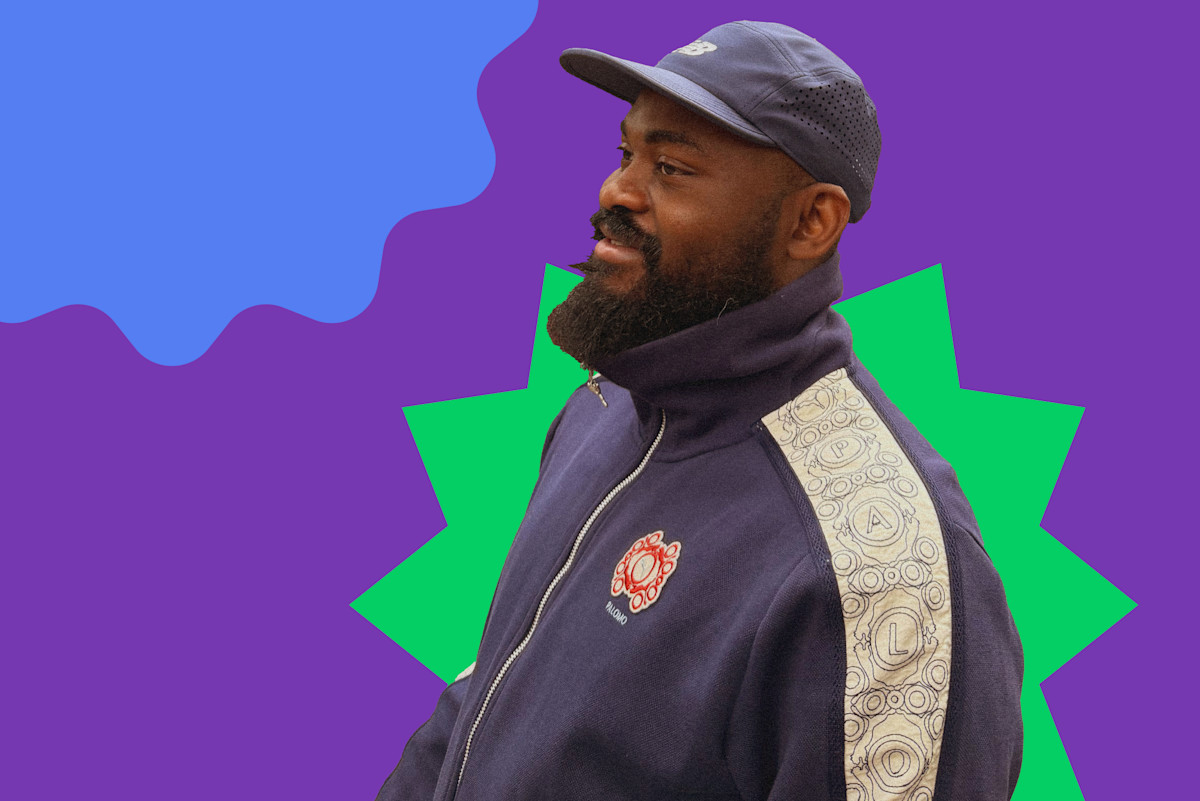
To hum a base line, you have to notice something most listeners might not: the low, repeating line beneath the melody, hold its movement in your memory, and reproduce it with your voice - a conspicuous attribute of concentration and observation is needed for this activity. At five years old, TMXO did that, an unusual thing for a child that age. At his grandma's house with his father, he was listening to a Notorious B.I.G. song on the radio, when he began humming the base line. Because of this and many other moments, it will be easy to declare him as musically gifted but TMXO doesn’t think he is.
So what is his talent?
“My talent isn’t music,” he says. “I think my talent is recognizing patterns and being able to, based on what I’ve seen, know, ‘Okay, this is going to come next.’” The other part is believing in the possibility of what is next enough to go for it. Music was in the lines that made up the patterns of TMXO’s life and he followed that sonic trail to the global stage.
Following the patterns, TMXO found his way along music’s sonic trail
TMXO is a Grammy-nominated producer. His early work included a production credit on a project featuring a then-rising Wizkid, long before the singer became one of the defining figures of a generation of Nigerian pop. Years later, TMXO worked on Burna Boy’s African Giant, the album nominated for Best World Music Album at the Grammys, producing “Different,” featuring Damian Marley and Angélique Kidjo.
If we were following the patterns in TMXO’s catalogue, the deduction might be that he is a historical marker himself, a producer who creates records for moments that would later become significant. First, a young Wizkid on an early project; years later, African Giant, an album that carried Nigerian afrobeats impressive run. He was there when Adekunle Gold became AG Baby, and when Tiwa Savage gave us Celia.
Before the extensive catalogue, TMXO was a curious child, always tinkering. In high school, TMXO customised uniforms and clothes, dyed Converse sneakers and attached Velcro to the collar of his shirt so he could snap it shut whenever a teacher approached. He turned Pringles containers into belt hardware when blinged-out belts were fashionable and made stencils for T-shirts. He knew how to look at something as it was and imagine another version of it.
TMXO Takes London with Love
“A woman was involved”
By 2022, TMXO felt like things had peaked for him in Lagos: he had worked with the people he wanted to work with in the Nigerian music scene, gotten Grammy nominated and so the natural question was: what next? A friend had suggested a Global Talent Visa in 2020, but he was too busy completing side quests in Nigeria: he went back to school and earned an MBA, then in 2022 he finally made the UK move. But he didn’t make that for himself alone, “A woman was involved” he adds, laughing.
Not much time was spent physically adjusting to London life; he had been travelling to the UK for years, had family and friends there, and was already familiar with the place. “The adjustment I had to do was mental,” he says. In Lagos life is different, there’s communal support, people aren’t governed by tight schedules and there’s a familiarity that makes daily living easier, so for a while, he wondered whether he should have stayed in Lagos; “sometimes you just get really lonely,” he says.
This is the difficult middle of diaspora life: you can build a life somewhere new and still find yourself missing home. But London works for the life he is building now - a family, a music adventure, and a city that gives him access to things he values. For TMXO, the move was an opportunity to see what might happen under different conditions.
42D4! Put your hands up, close your eyes, transcend
TMXO started DJing long before DJs became the main acts at parties around the world. He has always been the main character. He could take people through an hour-long journey, starting his set calmly, building to a peak and bringing the house down.
He once worked on an African Dance Music curation, or ADM, an initiative that functioned almost like an exchange programme: Nigerian producers reworked music from Universal’s international catalogue for Nigerian audiences, while Nigerian music was reworked for audiences outside the country. Now in the UK, he wanted to build something that could extend beyond the mushpit.
That became 42D4. It started with “Testy Fridays,” where TMXO posted sets and tested tracks he was considering for his DJ performances. When he was eventually offered a space, he took the experiment offline, booking DJs including Kwamz and Laelo Blac. The idea was to give music context, “Taste is the commodity, curation is the tool,” he says. “Curation gives taste context.”
The ambition is for 42D4 to become more than a series of sets or parties to a company that documents the African electronic music scene and the diaspora around it through magazines, exhibitions and other storytelling formats. He thinks about Ovation, the Nigerian magazine that once served as a kind of social archive, and asks where the equivalent exists for music now.
For now he is building 42D4’s community first. TMXO is chasing a particular feeling, he remembers hearing Lojay’s “Mona Lisa” for the first time and floating, “any song that can make me close my eyes and raise my hand, you’ve got me,” he says. That feeling is what he wants us all to experience through his sounds. And he is trying every day. “Today I’m still trying, tomorrow I’m still trying.”